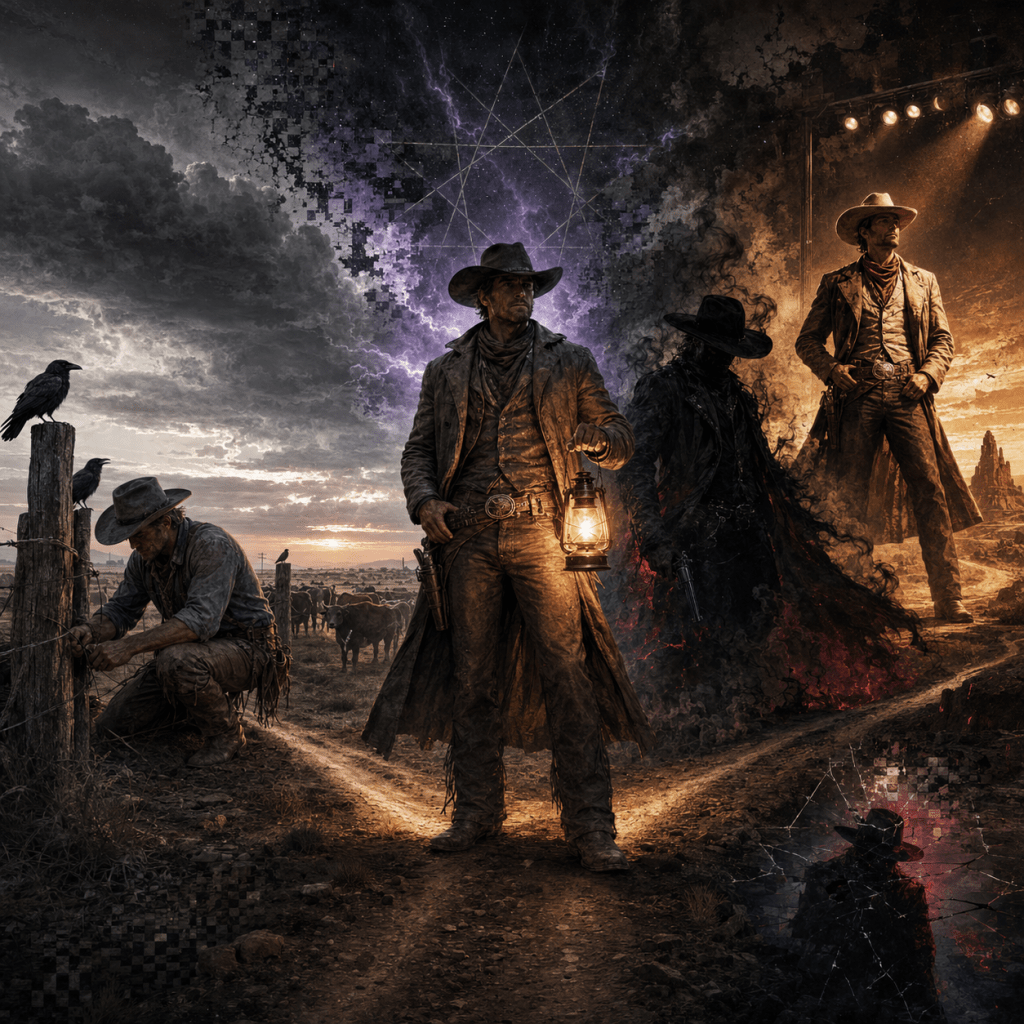
THE COWBOY ARCHETYPE
The Cowboy is the American knight—but where the knight belongs to a kingdom, the Cowboy belongs to the frontier.
He exists right on the line between civilization and wilderness. Behind him are the town, the church bell, the courthouse and the fenced pasture. Ahead of him are open country, uncertain weather, wild animals, outlaws and the unknown. He carries civilization into the wilderness—but the wilderness travels inside him, too.
Historically, the cowboy was a laborer. He herded cattle, repaired fences, slept beneath the sky and endured long stretches of boredom punctuated by moments of real danger. The archetype transformed this working man into something larger: the solitary rider, the gunslinger, the sheriff, the outlaw, the drifter who arrives from nowhere and disappears after the work is done.
His virtues are competence, courage, independence and restraint. The true Cowboy does not need to constantly advertise that he is dangerous. His clothes are practical. His words are few. His weapon remains holstered until the moment it is truly needed. He is judged by whether he can ride, shoot, work, endure and keep his word.
There is something distinctly “grey” about him. Dust-colored clothing. Weathered leather. Sun-bleached wood. A face partly concealed beneath the shadow of a hat. He does not peacock because the environment itself tests whether a man is genuine. On the frontier, appearance eventually collides with reality.
But every archetype casts a Shadow.
The Cowboy’s independence can curdle into isolation. His stoicism can become emotional paralysis. His courage can decay into recklessness, domination and an obsession with proving his manhood. The frontier can be imagined as empty only by forgetting the people who were already living there. The lawman and the outlaw may even wear the same hat; sometimes the only difference is who gets to tell the story afterward.
Then there is the commercial Cowboy: freedom packaged and sold back to us. The Marlboro Man is perhaps the purest example—a manufactured icon of masculine independence used to sell dependency. The cigarette becomes a little campfire held between the fingers. The “Cowboy Killer” carries both the romance and the death-drive of the archetype in one object.
The Cowboy Ascendent is not merely a lone man with a gun. He is someone capable of surviving alone who nevertheless chooses responsibility. He protects the herd. He watches the horizon. He knows when to ride out, when to stand his ground and when to return home.
Today, on the National Day of the Cowboy, I’m reflecting on that weathered figure riding along the border between history and mythology.
The trail goes on.
See you, space cowboy. 🤠
If you like this, make sure to check me out on twitter:
For further reading, here is a post from my subreddit, /r/dverse:
 dVerse Blog
Leave a comment