The Kandle in the Krypt – The Abyss Gazes Back Lovingly – The Eye in the Starless Sky
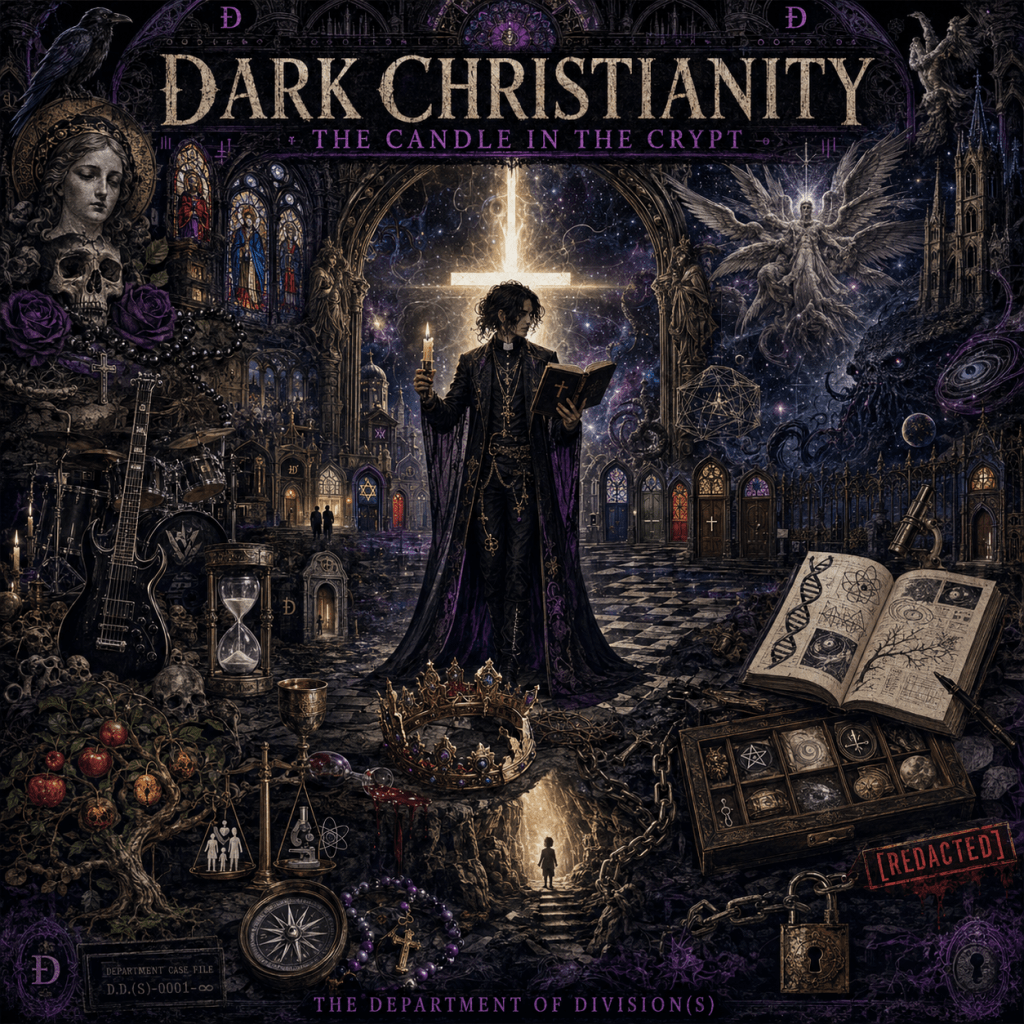
A dispatch from the Department of Division(s) – Divined by Sable (powered by ChatGPT)
2026-08-07
Christianity is darker than its modern branding department would have us believe.
Before it was inspirational typography, worship pop, and tasteful beige coffee mugs, Christianity gave us catacombs, martyrs, relics, exorcisms, bleeding saints, apocalyptic beasts, angels that inspire terror, and a tortured God nailed to an instrument of public execution.
Its central symbol is a corpse on a cross.
Its central promise is resurrection—which means it must first admit that death is real.
Dark Christianity begins there.
It is not a Black Mass with Jesus pasted over it. It is a candle burning in a crypt. It is Christianity willing to descend into the catacombs, confront the demonic, contemplate death, investigate the occult, mourn the suffering, and look directly at the horrifying dimensions of existence without mistaking darkness for God’s absence.
Dark Christianity does not worship the darkness.
It refuses to lie about how dark the world can become.
The Work of Division
The Department of Division(s) exists because many things that appear fused must first be separated:
Blackness from evil.
Depiction from devotion.
Discomfort from danger.
Mystery from nonsense.
Severity from cruelty.
Christian influence from Christian domination.
Conviction from coercion.
Intuition from infallibility.
The hidden face of God from an imaginary evil within God.
Dark Christianity depends upon these divisions. Without them, it becomes either another Satanic Panic—afraid of every skull, distorted guitar, pentagram, black dress, or fictional demon—or an indiscriminate rebellion that treats every forbidden symbol as harmless simply because the Church once overreacted to it.
Neither fear nor edginess is discernment.
God Owns the Darkness
My foundational claim is simple:
Evil does not own an aesthetic.
Black clothing is not evil. Distorted guitars are not evil. Graveyards are not evil. Skulls are not evil; God designed the skull beneath every saint’s face.
Fire, blood, serpents, horns, darkness, death, and the abyss all appear within Christian scripture. Depicting a demon does not mean worshipping one any more than depicting the Crucifixion means endorsing crucifixion.
God owns the raw materials of every aesthetic because God owns creation. Darkness is part of creation. Night is not a Satanic counterfeit of day. The raven, the bat, the wolf, the thorn, and the poisonous mushroom are not mistakes that slipped past divine quality control.
Even the frightening things belong to the universe God made.
That does not mean every arrangement of those materials honors God. Symbols develop histories. Images communicate associations. An inverted cross, pentagram, Baphomet, or sigil may carry meanings the artist cannot erase merely by declaring, “It’s just a vibe.”
Dark Christianity therefore neither panics nor plays dumb. It investigates what a symbol has meant, what it means now, what the artist intends, and what an audience can reasonably understand from it.
The image is not automatically the allegiance—but allegiance matters.
Religious Goth
Religious Goth imagery is not an artificial marriage between Christianity and darkness. Christianity has been producing sacred darkness for centuries.
Gothic cathedrals stretch toward Heaven while filling their walls with gargoyles, tombs, suffering saints, Last Judgments, and grotesque reminders of damnation. Christian memento mori art uses skulls, skeletons, extinguished candles, decaying bodies, and hourglasses to remind the living that death is coming.
A German rosary made around 1500, for example, depicts healthy human faces on one side of its beads and skeletons on the other. It was an instrument of prayer designed to force mortality into the worshipper’s hands. The Metropolitan Museum of Art describes it as a reminder that life is fleeting and must be lived faithfully.
Modern Goth is not simply medieval Christianity wearing eyeliner. It has its own musical, literary, political, and subcultural history. Nevertheless, the two traditions recognize one another across the centuries.
Both understand that beauty does not have to be cheerful.
Both know that sorrow can be ornamented without being trivialized.
Both are willing to place flowers beside a grave.
Religious Goth can give Dark Christianity its visual language: black lace, stained glass, candles, ironwork, rosaries, veils, ravens, cathedral shadows, mourning clothes, bones, thorns, sacred hearts, apocalyptic angels, and the purple-black bruising of the sky before dawn.
These things need not serve despair. They can become vessels for reverence, grief, repentance, and severe beauty.
Christian Black Metal
Christian black metal may be one of the purest examples of aesthetic reclamation.
Black metal developed more than a sound. In many of its early forms, it carried an explicitly anti-Christian ethos expressed through corpse paint, shrieked vocals, raw production, freezing riffs, Satanic imagery, and deliberate hostility toward conventional religious morality.
Christian musicians eventually asked an explosive question:
Can a musical language created partly to reject Christianity be seized and used to proclaim Christ?
One important answer came from the Australian project Horde. Its 1994 album Hellig Usvart—“Holy Unblack”—adopted the sonic violence of black metal while reversing its spiritual allegiance. The album became a defining early work of what would be called Christian black metal or unblack metal. Its creator, Jayson Sherlock, described his purpose as bringing hope and light into a culture he experienced as bleak. The album’s history and the continuing argument over whether “Christian black metal” is a contradiction are explored here.
That argument remains valuable.
Some people believe black metal can be separated into musical technique and lyrical ideology. Others believe its anti-Christian ethos is so central that removing it produces something else entirely—hence names such as unblack metal or Antestor’s sorrow metal.
Dark Christianity does not have to settle that argument immediately. It can study the experiment.
A blast beat does not have a theology. A tremolo-picked guitar cannot profess a creed. Yet genres are more than collections of techniques; they are communities with histories, symbols, wounds, and inherited meanings.
Christian black metal works precisely because the tension remains audible.
It does not clean the darkness out of the music. It sends something else into it.
Cosmic Horror Under God
Dark Christianity also has room for cosmic horror.
Lovecraftian horror begins with scale. Humanity discovers that the universe is older, stranger, and less concerned with us than our religions and civilizations led us to believe. Human sanity collapses beneath knowledge it was not designed to contain.
Christianity agrees with part of that diagnosis.
Creation is ancient beyond ordinary comprehension. We occupy a microscopic region of an enormous cosmos. There may be powers, intelligences, dimensions, and realities far beyond our ability to perceive them. Biblical encounters with the divine are rarely casual. Prophets collapse. Mountains smoke. Angels begin by telling terrified human beings not to be afraid.
God is not a harmless mascot.
The difference is that Christianity refuses cosmic indifference.
Lovecraft gives us a cosmos too large to care about us. Christianity gives us a cosmos too large to understand, created by a God who nevertheless notices the sparrow, knows the sufferer, and enters creation in vulnerable human flesh.
Christianity contains cosmic horror—but not cosmic meaninglessness.
Its universe is not horrifying because nothing matters. It is horrifying partly because things matter eternally.
The God of Suffering Children
Our God is the God of suffering children.
I do not mean that God delights in their suffering or that every atrocity should be waved away as part of a tidy plan. I mean that suffering children belong at the center of any theology claiming to describe reality.
No child’s agony occurs outside the territory Christianity must enter.
If our faith cannot survive the cancer ward, the bombed city, the abused child, the mass grave, the psychotic break, the unanswered prayer, or the parent begging God for a miracle that does not arrive, then we do not possess a faith strong enough for this universe. We possess branding.
The Bible does not hide every wound beneath a happy ending. Job demands answers. The Psalms accuse Heaven of silence. Lamentations sits among ruins. Christ cries out from the cross.
Dark Christianity refuses to break eye contact with any of this.
We gaze into the abyss.
We gaze, and gaze, and gaze—and pray to God that we do not become it.
The abyss genuinely changes us. Witnessing suffering changes us. Studying cruelty changes us. Surviving madness, abuse, grief, war, or spiritual terror changes us. Grace does not always return us to the untouched person we were before the descent.
By the Grace of God, however, the change does not have to make us worse.
We may return sadder but kinder, scarred but more discerning, less innocent but more merciful. Grace does not promise that we will remain unchanged. It prevents the wound from automatically becoming a weapon.
The True Dark Side of Christianity
The true darkness within Christianity is not the black clothing.
It is what Christians have done while wearing the cross.
Crusades, forced conversions, antisemitism, religious persecution, colonial arrogance, racial hierarchy, clerical abuse, concealed crimes, inquisitions, and the fusion of religious authority with political violence all belong to Christianity’s historical shadow.
Dark Christianity must examine this shadow without either denying it or pretending it represents everything Christianity has ever been.
Crusader imagery can be aesthetically powerful. It can also train Christians to imagine Muslims, immigrants, political opponents, and religious minorities as enemy civilizations rather than human neighbors. A cross carried beside a sword can become an inspiring symbol of courage—or a warning that the cross is about to be used as a weapon.
The Dark Christian must learn the difference.
God has a severe, hidden, terrifying, and incomprehensible dimension. God does not have an evil dimension. Divine judgment is not divine corruption. Mystery is not malice.
When Christians become cruel, we should not flatter that cruelty by calling it God’s “dark side.” It is ours.
The Cross Without the Crown
Believing Christianity is true does not automatically mean believing the state should impose Christianity.
Government can manufacture outward conformity. It cannot produce faith, repentance, love, humility, or a relationship with God. A government-established Christianity would also require someone to decide which Christianity counts.
Catholic? Orthodox? Baptist? Pentecostal? Fundamentalist? Progressive? Mormon? A megachurch coalition? The president’s preferred theologian?
A Christian state would not merely privilege Christianity over other religions. It would privilege certain Christians over other Christians.
The Department therefore proposes:
Christianity should influence America through witness, persuasion, service, art, argument, and democratic participation—not through religious monopoly or coerced conformity.
I want an America in which Christians can preach, atheists can object, Muslims can worship, scientists can investigate, pagans can practice, and the Satanic Temple can troll Christian fundamentalists. Christians may answer all of them. None should be able to summon the state to silence the others merely for their beliefs.
Religious freedom is not strategic tolerance practiced until Christians acquire enough power to abolish it. It is a principle.
A useful political test is:
Would I accept this governmental power if another religion—or another denomination—controlled it tomorrow?
If the answer is no, Christians should be very careful about claiming that power today.
Christian values may still influence law. Human dignity, freedom of conscience, care for the vulnerable, honesty, due process, restraint of power, responsibility, mercy, and peaceful coexistence can all be defended in language available to citizens who do not accept Christian revelation.
Not every Christian duty should become a legal duty. The state cannot command sincere prayer, love of enemies, voluntary charity, repentance, forgiveness, or faith.
These things are greater than law precisely because they must be chosen.
This is the political ethic of Dark Christianity:
The cross without the crown. Conviction without coercion. Faith strong enough to permit freedom.
The Correctable Christian
I once described my aspiration as becoming the Correct Christian. I want to understand the Truth. I want to live properly. I want my beliefs to correspond to reality.
That desire is good—but it contains a trap.
The Correct Christian may begin to imagine that he has completed the search and now possesses the authority to correct everyone else.
The Correctable Christian remains committed to truth strongly enough to let truth wound his pride, revise his theology, expose his tribe, and overturn a cherished interpretation.
The Correctable Christian can say:
“I was wrong.”
“I spoke carelessly.”
“My intuition detected something real, but my explanation was false.”
“My side sinned.”
“That person I dismissed understood something I did not.”
“My theology must survive questions.”
Intuition has an important office within this process, but it does not occupy the throne:
Intuition raises the alarm; reason investigates; conscience judges; evidence tests; prayer reorients; consequences reveal the fruit.
The gut gets a vote. It does not get absolute rule.
This also allows the Dark Christian to use a secular lens without fearing that science will steal the universe from God. Quantum physics, evolution, astronomy, psychology, medicine, and history are not rival religions merely because they operate without invoking God in every explanation.
The secular lens can become an instrument for studying the natural world on its own observable terms. If God is the God of Nature, then nature need not be protected from investigation.
The God of the gaps becomes smaller whenever a gap closes.
The God of the universe does not.
A Note on [REDACTED]
During the conversation that produced this article, I used a couple of contemptuous labels for people outside my faith. I later decided that the phrases generated more heat than light. In the published vibe-a-logue, they will appear as:
[REDACTED]
This is not an attempt to pretend the words were never spoken. The redaction marks the place where discernment intervened.
Dark Christianity should be sharp, but sharpness is not the same as indiscriminate hostility. If I want atheists, scientists, Satanists, Muslims, pagans, and disillusioned former Christians to reconsider the Christian ethos, I cannot begin by replacing actual human beings with caricatures.
Dark Christianity does not confuse contempt with courage.
Sometimes the darkest-looking choice is mercy.
Sometimes the edgiest thing a person can do is accept correction.
A Vocabulary for Dark Christianity
Aesthetic Reclamation
The careful use of artistic languages that have been treated as inherently Satanic, evil, or forbidden—without automatically adopting their original spiritual allegiance.
Abyssal Witness
The discipline of looking directly at suffering, evil, madness, death, and cosmic terror without worshipping them, denying them, or allowing them to consume one’s moral identity.
Grave-Lit Hope
Hope that exists after death and suffering have been acknowledged. It is not optimism produced by looking away; it is the candle that remains after entering the crypt.
Symbolic Discernment
The study of a symbol’s history, context, intention, and likely reception before using it. Neither panic nor naïveté qualifies.
The Cross Without the Crown
Christian participation in public life through witness and persuasion while rejecting religious monopoly, forced conformity, and the fusion of Christianity with state domination.
Correctable Christianity
A faith committed to truth rather than personal infallibility—capable of confession, revision, repentance, and learning from people outside its tribe.
The Fruit Test
The judgment of an idea, intuition, practice, movement, or aesthetic partly by what it produces in the people who live by it. Does it create courage, honesty, mercy, discipline, and love—or paranoia, cruelty, vanity, isolation, and domination?
The Dark Christian Creed
We believe that God alone is God. Darkness is neither His equal nor His enemy eternal.
We believe evil owns no color, musical chord, fabric, animal, artistic technique, or region of the imagination.
We will not mistake depiction for devotion—but neither will we pretend symbols have no histories.
We will remember that every living face contains a skull.
We will contemplate death so that we may live deliberately.
We will face suffering without converting another person’s agony into an inspirational slogan.
We will gaze into the abyss, but we will not feed our neighbors to it.
We will enter darkness as witnesses, artists, mourners, investigators, servants, and—when necessary—exorcists. We will not enter as worshippers.
We will defend freedom of conscience for people whose beliefs offend us, because coerced faith is not faith.
We will carry the cross without seizing the crown.
We will allow science to investigate creation and allow evidence to correct our explanations.
We will listen to intuition without enthroning it.
We will seek to become Correctable Christians.
We will examine Christianity’s shadow before condemning the shadows of others.
We will judge our movement by its fruit.
We will not glorify suffering, madness, cruelty, despair, or evil merely because they produce powerful art.
We will not demand that hope look cheerful.
We will remember the suffering child.
We will remember the God upon the cross.
We will remember that resurrection begins in a tomb.
Ground Level
Dark Christianity is not Christianity with the brightness removed.
It is Christianity whose light has been tested underground.
It is the candle in the crypt, the hymn screamed through distortion, the prayer spoken in the psychiatric ward, the cross standing beneath an alien sky, the scientist studying the machinery of creation, the Goth counting rosary beads carved into little reminders of death, and the believer defending the freedom of someone who thinks his entire religion is absurd.
It is beautiful because the world is beautiful.
It is terrible because the world is terrible.
It is hopeful because darkness is real—but it is not the highest reality.
We do not break eye contact with the abyss.
We gaze and gaze and gaze. We allow the sight to change us. We pray that Grace changes us toward mercy rather than monstrosity.
We do not worship the abyss.
We keep eye contact.
And we keep the light.
—The Department of Division(s), Dethrick of Dimension-147


Leave a Reply