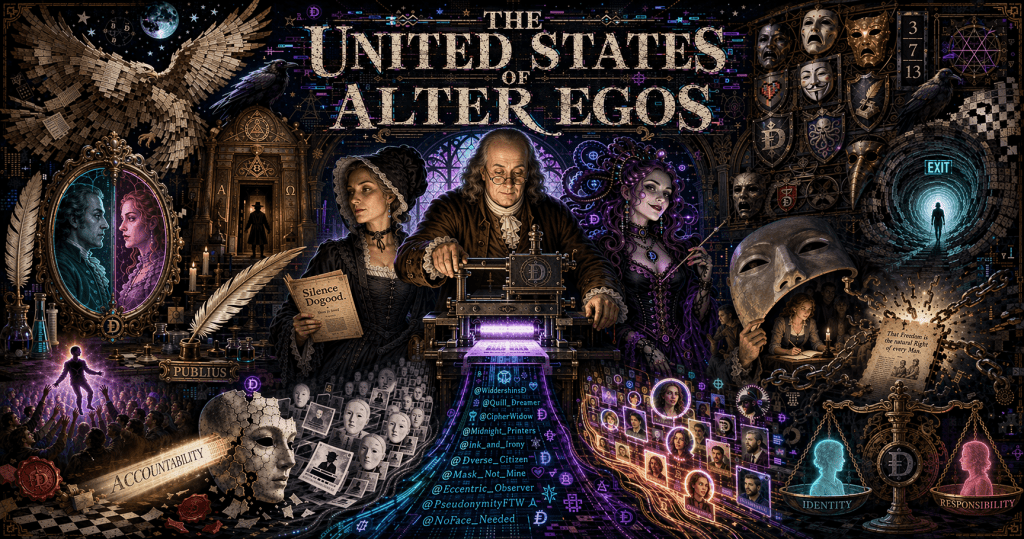
Filed at 13:05 by the Department of Division
Bureau of Masks, Handles & Second Selves
2026-08-12
Benjamin Franklin deserves to be called a Founding Grandfather.
It is not merely that he was older than many of the revolutionaries surrounding him. He possesses the energy of an eccentric national grandfather: inventor, printer, diplomat, philosopher, civic organizer, Freemason, occasional troublemaker, professional advice-giver, and the sort of man who might walk into your home carrying a kite, a printing press, and several political identities.
I almost spelled his name Benjamin Cranklin while beginning this project.
Frankly, that sounds like one of his pseudonyms.
Franklin did not merely help create the United States. Long before the country existed, he experimented with one of the liberties that would become deeply American:
The liberty to enter public life as someone other than yourself.
At sixteen years old, Franklin created Mrs. Silence Dogood, the outspoken middle-aged widow of a minister. He slipped her writing under the door of his brother’s newspaper, The New-England Courant, because the apprentice Benjamin Franklin could not enter the publication as himself. Silence could.
The Courant published fourteen of her essays during 1722. She discussed religion, education, fashion, courtship, hypocrisy, and freedom of expression. The young man was barred from the room, so he invented a woman who could walk through the wall. The Massachusetts Historical Society preserves the surviving Dogood essays, including her forceful defense of freedom of thought and the press.
Silence Dogood was not transgender in our modern sense. She was a gendered literary persona: a fully imagined social identity through which Franklin could write things differently, observe society from another position, and evade the prejudice attached to his ordinary name.
I understand the instinct.
I, too, have a female alter ego: Cthulha.
Cthulha is not simply Deethrick wearing a nametag that says “woman.” She is a vessel for particular energies, images, jokes, insights, and modes of speech. She gives certain thoughts a body. When Cthulha speaks, the words still originate somewhere within me, but they do not emerge in precisely the form they would have taken through Dethrick Shade.
Silence Dogood and Cthulha are not identical creatures.
They are, however, citizens of the same invisible republic.
The Masked Republic
The American political tradition did not begin with everybody displaying a government name and verified photograph beside every opinion.
It began amid unsigned pamphlets, borrowed Roman names, newspaper aliases, private clubs, confidential correspondence, and arguments whose authorship was sometimes deliberately obscured.
Alexander Hamilton, James Madison, and John Jay defended the proposed Constitution under the shared name Publius. Their political opponents answered through names such as Brutus, Cato, and Federal Farmer. The arguments that became The Federalist Papers first entered public life without the identities of their individual authors attached. The mask allowed three people to speak through one republican ghost. The National Archives describes how the Publius essays circulated through New York newspapers.
Pseudonymity was not treated as automatic proof of cowardice. It could protect the writer from retaliation, direct attention toward the argument, create a consistent voice, or permit several writers to occupy one symbolic identity.
The Supreme Court would later recognize anonymous political advocacy as part of the American free-speech tradition. In McIntyre v. Ohio Elections Commission, it struck down a prohibition on anonymous campaign literature. A citizen did not surrender her political voice merely because she declined to print her legal name on the pamphlet. Oyez provides the case and decision.
This does not prove the founders would have liked 4chan or Reddit. We cannot transport historical people into a technological culture and confidently predict which memes they would upvote.
They would, however, recognize the architecture.
They knew the anonymous pamphlet.
They knew the recurring pen name.
They knew the private debating society.
They knew the political faction organized through correspondence.
They knew the danger of attacking the writer when one could not defeat the writing.
The American Internet did not invent masked speech.
It electrified it.
Anon, Handle, Face
There are three broad ways to enter the digital square.
Anonymity removes the durable public identity. On 4chan, most participants simply become Anonymous. A post must largely survive without the support of the poster’s résumé, follower count, previous opinions, or carefully cultivated brand.
Pseudonymity creates a durable alternative identity. Reddit handles, gamer names, authorial pen names, avatars, and dVerse entities can acquire histories and reputations. A pseudonym may not reveal the human being’s civil identity, but it can still become accountable to its own record.
Real-name identity connects speech to the person’s recognized social existence. This supplies context and accountability, but it also invites status worship, prejudice, retaliation, doxxing, and ad hominem warfare.
None of these systems is automatically virtuous.
Anonymity can free an idea from social rank. It can also free cruelty from embarrassment.
Pseudonymity can permit honest experimentation. It can also support elaborate deception.
Real names can encourage responsibility. They can also make every argument a referendum on the speaker’s race, sex, occupation, appearance, diagnosis, religion, class, and past mistakes.
4chan is something like a tavern wall covered in messages after the signatures have been torn away. Reddit is closer to a federation of guild halls populated by masked regulars. The usernames remain stable enough to develop reputations, but the citizen beneath the handle can remain concealed.
One major study of 4chan found that more than ninety percent of its posts were made fully anonymously. The researchers argued that anonymity and ephemerality did not prevent a recognizable culture from forming; those conditions helped produce its unusual culture. The study is available through AAAI.
If I may commit a little imaginative history, Franklin would probably be fascinated by both platforms.
He would create a dozen handles, organize r/Junto, [[[Dethrick: Junto is explained further down]] publish civic questions under one username, flirt under another, test arguments on 4chan, and eventually reveal that three people everyone had been fighting with were Benjamin Franklin.
John Adams would write a 7,000-word reply.
Hamilton would still be posting at four in the morning.
The Person Is Not the Argument
My instinct is that ideas should first be presented without giving the audience an easy opportunity to attack the person presenting them.
Bad men can have good ideas.
Good men can have bad ideas.
Neutral men can have polarizing ideas.
Polarizing men can have neutral ideas.
Women can do all of the above—and, yes, I have used men in the deliberately dated sense.
A person’s wickedness does not create a magical anti-truth field around every sentence he speaks. A saint’s good character does not convert every mistake into wisdom. Hitler could correctly report the weather. A beloved humanitarian could misunderstand economics. A political enemy may identify one of our genuine weaknesses. A trusted friend may confidently repeat nonsense.
That does not mean identity and history are always irrelevant.
If someone presents a mathematical proof, the proof can be tested without inspecting his soul.
If someone asks to borrow money, claims personal victimhood, sells medicine, reports an event only she witnessed, or promises that political power will not corrupt him, then character and history become evidence.
The Department therefore proposes a three-stage examination:
Argument first. Provenance second. Consequences third.
First ask whether the idea is coherent and supported.
Then ask where it came from, what incentives surround it, and what the speaker may know or conceal.
Finally ask what happens when the idea is acted upon.
The person is not the argument.
The argument is not completely severed from the person.
Societies with Secrets
America was constructed through public documents—but also through private rooms.
Franklin founded the Junto, a weekly club of tradesmen who discussed morality, politics, business, natural philosophy, and the books they had read. Their pooled intellectual and financial resources eventually helped create the Library Company of Philadelphia. The Library Company describes the Junto as a club for civil discussion and mutual improvement.
Franklin was also a Freemason and became a Grand Master in Pennsylvania. That fact does not prove that the American Revolution was secretly written on the back of a Masonic apron. It does demonstrate that Franklin understood ritual, restricted knowledge, brotherhood, symbolism, initiation, and organized trust. The Pennsylvania Masonic Temple records Franklin joining a lodge in 1731.
A secret society is not necessarily evil.
Sometimes it is more accurately a society with secrets.
Fraternities and sororities use ritual to transform strangers into siblings. Professional orders protect specialized knowledge. Religious communities preserve mysteries. Guilds regulate crafts and establish obligations among members. Gamer clans create insignia, ranks, initiation rites, shared language, collective memory, and digital territory.
Even a small Discord server can become a kind of lodge.
The secret creates an interior. The ritual tells the members that crossing the threshold matters.
But secrecy has a dark side. It can protect corruption, demand conformity, create false feelings of superiority, and permit members to do together what they would be ashamed to do alone.
The Ku Klux Klan demonstrates the distinction with hideous clarity.
The Klan did not use anonymity merely to make controversial arguments. Its hoods helped produce intimidation and impunity. The hidden identity was attached to racial terror, political coercion, and violence. The mask did not merely protect the speaker from the mob.
The mask belonged to the mob.
The dVerse is not a racist identity. The Klan and its racial caste ideology are our political enemies. Anti-racism, at minimum, means refusing to convert ancestry and appearance into a hierarchy of citizenship.
Yet even here, republican discipline matters. Klansmen who are American citizens retain legal rights. Their ideology should be opposed, exposed, answered, defeated, and—when it crosses into crime—prosecuted under law. Political enmity should not become permission to abandon due process.
The proper division is:
Protect masked speech. Do not protect masked violence.
A pseudonym may shield a speaker from retaliation.
It must not become immunity for threats, fraud, stalking, conspiracy, or assault.
Rowling and the Gendered Name
J.K. Rowling gives this subject tremendous doura—that strange narrative charge produced when several ideas collide inside one person.
Her birth name is Joanne Rowling. Her publisher advised her to use initials so that boys would not immediately know the books had been written by a woman. She had no middle name, so the K came from her grandmother Kathleen. “J.K. Rowling” became a professional identity capable of being read as male, female, or simply unknown. Rowling later adopted the explicitly male pseudonym Robert Galbraith so her crime writing could be judged without the gravitational force of Harry Potter. Rowling’s official account explains both names.
The writing did not change when the presumed sex of the author changed.
The reception did.
That matters because Rowling later became one of the most prominent critics of gender self-identification and several positions associated with contemporary transgender politics. Her own name-history demonstrates that gendered assumptions affect how identical words enter society. Her later arguments insist that sex remains meaningful regardless of how a person names or presents herself.
It would be cheap to reduce this to “Rowling is a hypocrite.”
The tension is more interesting than the gotcha.
Her career demonstrates that a person can alter the social interpretation of a work by controlling the gender information attached to it. Her politics argues that controlling that information does not necessarily alter every material reality beneath it.
Both observations can exist at once.
A name can change how society treats a person without changing that person’s body.
Society’s treatment is not imaginary simply because the body remains.
The Raw Identity and the Made Identity
Human beings are born into what I will call raw jungle identity.
A body.
A sex.
An ancestry.
A family.
A location.
A collection of biological capacities and limitations.
A person does not choose these starting materials.
Civilization then covers the raw creature with constructed identities: names, clothing, citizenship, religion, occupation, titles, marriages, guild membership, education, political affiliation, artistic style, and social role.
These things are “made up,” but made up does not mean unreal.
Money is made up.
The presidency is made up.
A wedding vow is made up.
The alphabet is made up.
All of them can change lives.
America is, among other things, a great persona machine. Immigrants adopt American names. Converts receive religious names. Artists create stage identities. Married people change surnames. Monks enter orders. Soldiers wear ranks. Gamers become Deathlords. Writers become widows. Citizens join nations that did not exist when their ancestors were born.
The American promise is not that biology disappears.
It is that birth need not dictate the entire script.
Transgender People, Politics, and “Transgenderism”
The Department must perform another division.
Transgender people are people.
Transgender politics is a field of competing moral, medical, legal, linguistic, and institutional claims.
Transgenderism is a loose umbrella term that often merges the people and the politics into one supposedly unified ideology.
That merger causes unnecessary cruelty. Disagreeing with a policy does not justify contempt for a person. Respecting a person does not require surrendering every policy question.
Transgender identity has a place in American culture.
More strongly: transgender Americans have a place in America.
A person may adopt another name, alter clothing and appearance, resist the gender role assigned at birth, live socially as another gender, and pursue happiness without being hunted, humiliated, or stripped of ordinary citizenship. For many people, this is not a costume worn for an evening. It is the durable identity through which they work, love, pray, suffer, and participate in society.
My relationship with Cthulha can help me understand identity’s flexibility, but it is not identical to the lived experience of a transgender person. An artistic alter ego may be episodic; a transgender identity may structure an entire embodied life.
Analogy can illuminate without erasing difference.
Cultural disagreement also deserves a lawful place. Conservatives, religious believers, gender-critical feminists, parents, physicians, athletes, and others raise questions about sex-based language, medicine, children, sports, prisons, privacy, and the boundaries of compelled recognition. Those questions cannot all be dissolved by calling the questioner hateful.
Transgender people and their advocates raise equally real concerns about harassment, employment, medical access, family rejection, political scapegoating, and the danger of turning private citizens into symbols of civilizational collapse.
Those concerns cannot all be dismissed as ideology.
A free country should protect wide adult liberty while preserving room for argument about contested institutions. It should be slow to criminalize identity—and equally slow to declare one disputed metaphysics beyond discussion.
Cultural forces deserve consideration.
They do not receive automatic victory.
The Borderlands of Identity
There is an old Internet joke that says:
Only in America could a young Black boy grow up to become a successful white woman.
The target is Michael Jackson. The joke is sharp, memorable, cruel, and inaccurate as biography. Jackson did not identify as a woman, and the changes in his skin were not a declaration of transracial identity.
A joke can be a falsehood wearing clown makeup.
Rachel Dolezal presents a more direct border case. Born to white parents, she publicly lived and worked as a Black woman until her ancestry and earlier identity became national news. Her claim to a transracial identity has been broadly rejected across the political spectrum.
Race and sex are not interchangeable categories. They have different relationships to ancestry, embodiment, community, discrimination, reproduction, medicine, and history. The existence of transgender identities does not automatically validate every transracial claim.
Neither does social rejection make the analogy philosophically meaningless.
It raises the question: Which parts of identity may an individual author, and which require recognition by a body, ancestry, community, institution, or history?
Fiction can explore the question more freely than public policy.
A character can change race, species, age, sex, body, universe, or metaphysical category. Fiction permits identity experiments without immediately demanding that schools, hospitals, courts, prisons, or communities reorganize themselves around the experiment.
The imagination has wider borders than legislation.
The right to imagine a self is broader than the right to compel every other person to interpret that self identically.
BreadTube and the Manufactured Person
At the anonymous end of the Internet, the individual disappears into the crowd.
At the influencer end, the crowd enlarges the individual until one person fills millions of screens.
The YouTuber, Twitch streamer, podcaster, and influencer are not merely people broadcasting ideas. They are recurring characters. Lighting, costumes, editing, sets, usernames, thumbnails, vocal habits, disclosures, jokes, and audience rituals assemble a public persona.
The influencer is a pseudonym with a face.
BreadTube provides a particularly useful example. The term describes a loose, disputed network of left-wing video essayists and streamers that formed partly in response to the online influence of the alt-right. Its creators have discussed socialism, feminism, race, fascism, sexuality, transgender identity, media, philosophy, and Internet culture—often through elaborate theatrical presentations. Recent scholarship describes it as a left-wing YouTube counterpublic while also noting its fragmentation and contested membership. The Association of Internet Researchers published a useful study in 2025.
Some of the most visible creators associated with this world have been transgender, queer, costumed, pseudonymous, or otherwise engaged in conscious self-creation. Their work demonstrates that an argument can arrive through makeup, characters, jokes, philosophy, confession, set design, and spectacle all at once.
That richness has power.
It also complicates the dream of evaluating the idea apart from the person.
The audience does not merely receive an argument. It develops a relationship with the presenter. The creator becomes teacher, entertainer, actor, confidante, political guide, and recurring presence in the viewer’s private life.
This is a parasocial relationship: thousands or millions of people feel they know someone who cannot possibly know most of them.
The crowd elevates an individual in society.
Then the crowd may begin treating the individual as prophet, friend, enemy, parent, priest, crush, traitor, or emotional property.
Anonymity can remove too much personhood from an idea.
Influencer culture can attach far too much.
Radicalization in the Secret Room
Anonymity and pseudonymity create spaces where people can explore ideas they would be afraid to discuss under their legal identities.
That liberty protects dissidents, whistleblowers, abuse survivors, religious minorities, queer teenagers, workers criticizing employers, patients discussing embarrassing conditions, and citizens living under oppressive governments.
It also protects liars, manipulators, recruiters, extremists, harassers, and people performing increasingly vicious versions of themselves for applause.
A private identity can become a pressure chamber.
A joke becomes a worldview.
A worldview becomes a tribe.
The tribe supplies new language.
The language reorganizes perception.
Soon every news story confirms the tribe’s theory, every outsider becomes an enemy, and every doubt feels like betrayal.
This can happen on 4chan.
It can happen on Reddit.
It can happen in BreadTube communities, conservative networks, religious groups, fandoms, gamer clans, fraternities, conspiracy circles, activist spaces, and private group chats.
It can even happen under legal names.
Research summarized by the Knight First Amendment Institute warns that anonymity can facilitate deception and extremism—but also finds that mandatory identification can intensify polarization and suppress valuable participation. Anonymity has no fixed moral effect; the surrounding norms and architecture matter. The Institute’s survey is worth reading.
The danger is real.
It is also an acceptable danger for a free America.
Acceptable does not mean desirable. It means that eliminating the danger would require powers more dangerous than the problem.
We can moderate conduct.
We can remove threats.
We can prosecute crimes.
We can label manipulation.
We can limit brigading and impersonation.
We can teach citizens to recognize propaganda, cult dynamics, artificial consensus, and parasocial dependency.
We should not require every person to expose a civil identity before entering public thought.
Liberty and Temporary Safety
Franklin’s famous sentence is often paraphrased as:
“Those who would give up Essential Liberty, to purchase a little temporary Safety, deserve neither Liberty nor Safety.”
The quotation should be used carefully. It came from a 1755 dispute between the Pennsylvania Assembly and the colonial governor over taxation, legislative self-government, and funding frontier defense. Franklin was not writing a universal slogan declaring every safety measure tyrannical. Lawfare provides the historical context.
Still, the sentence survives because it expresses something larger than its occasion.
A free society cannot eliminate every danger without eliminating the conditions that make it free.
The printing press produced lies.
Religious liberty produced strange sects.
Political association produced conspiracies.
Private correspondence produced sedition.
The Internet produces radicalization.
The answer cannot always be to destroy the liberty that made the danger possible.
Liberty is managed risk.
It is the national decision to trust citizens with intellectual weapons—and then teach them not to fire blindly into the crowd.
Countrymen, Not Enemies
America needs places where political opponents can encounter one another without first demanding surrender.
Not every space must host every opinion. A fraternity may preserve its internal rituals. A subreddit may establish a subject and rules. A church may teach its doctrine. A transgender support group need not become an open debate stage. A conservative club need not pretend it has no beliefs.
Freedom of association includes the freedom to form particular associations.
But the broader republic requires crossing points: forums, publications, debates, civic groups, libraries, and digital halls where disagreement can occur without warfare.
Countrymen should strive not to become enemies of their fellow citizens.
Some ideologies—including racist terror movements—remain political enemies of the dVerse. Even then, the objective is not to transform every human being within them into an untouchable demon. The objective is to defeat the ideology, protect its targets, enforce the law, and leave open a road by which a person may abandon error.
A republic requires exits.
People must be allowed to change their minds without being told that their past identity is their eternal essence.
That, too, is a kind of transition.
The Creed of the Masked Republic
We believe the person is not the argument—and the argument is not entirely severed from the person.
We will examine the idea before reaching for the biography.
We will examine the biography when trust, incentive, experience, or conduct makes it relevant.
We will protect anonymous speech without granting immunity to anonymous crime.
We will remember that a pseudonym can be more honest than a legal name.
We will remember that a legal name can carry responsibilities a pseudonym cannot escape.
We will not mistake constructed identity for nonexistent identity.
We will not mistake inherited identity for inevitable destiny.
We will defend the liberty of transgender Americans to participate in society without demanding that every philosophical and political question be declared closed.
We will permit disagreement without permitting dehumanization.
We will respect cultural forces without making culture an absolute veto over individual liberty.
We will distinguish artistic alter egos from embodied lives while allowing each to teach us about the other.
We will not permit secret societies to turn secrecy into supremacy.
We will oppose the Klan, racial caste, and political terror.
We will not allow a crowd to convert a creator into a priest.
We will not allow hatred of an influencer to replace examination of the influence.
We will enter guilds without surrendering judgment.
We will enter rabbit holes with an exit strategy.
We will allow countrymen to be opponents without automatically making them enemies.
We will remember that the mask can protect the vulnerable—or conceal the predator.
We will judge the mask by what the person does while wearing it.
Ground Level
Silence Dogood entered American public life before the United States existed.
A teenage boy imagined a middle-aged woman, gave her a biography and a voice, and sent her into a newspaper to argue about society. Decades later, masked authors debated the Constitution. Centuries later, Anonymous posts on 4chan, handles acquire histories on Reddit, BreadTubers build theatrical political selves, writers obscure their gender, gamers become guildmasters, and Cthulha speaks through me.
The mask remains.
Sometimes it allows an idea to live.
Sometimes it allows a person to live.
Sometimes it releases the monster a social identity had kept restrained.
The American principle should not be that everyone must remain what he appeared to be at birth. Neither should it be that every self-declaration automatically overrules body, history, community, evidence, and consequence.
The principle is liberty joined to discernment.
You may choose a name.
You may build a persona.
You may join a lodge.
You may leave a tribe.
You may become socially strange.
You may speak without supplying the mob with your home address.
You may experiment with the distance between your jungle identity and your chosen identity.
You remain responsible for what your chosen self does.
Benjamin Franklin became Silence Dogood so that an idea could enter the room.
The Ku Klux Klan wore hoods so terror could enter the room without accountability.
That is the division.
The mask is neither sacred nor Satanic.
It is an instrument.
Put it on when it frees the truth.
Remove it when responsibility requires your face.
Keep it when exposure would merely feed the mob.
And never confuse the mask—however beautiful, liberating, frightening, masculine, feminine, anonymous, pseudonymous, or magnificently dVersian—with the totality of the soul beneath it.
—The Department of Hidden Things
Bureau of Masks, Handles & Second Selves


Leave a comment